

ACME Gears Mission
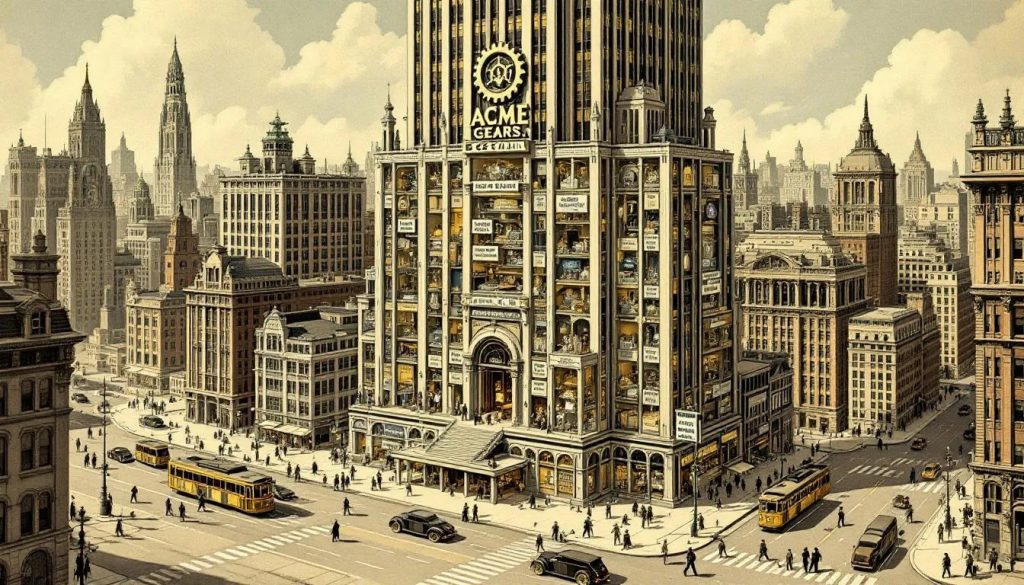
ACME Gears: Educational Mission for Geography & History Instruction
A Statement for Teachers
At ACME Gears, our goal is to equip students with a deep, interconnected understanding of the world—past and present—by empowering teachers to guide learners through meaningful, engaging, and inquiry-driven study of geography and history. We believe that when students can see the world clearly and understand its story, they are better prepared to think critically, act wisely, and navigate complexity with confidence.
1. Cultivating Global Awareness Through Geography
ACME’s approach to geography emphasizes more than the memorization of capitals or the identification of mountain ranges (though those matter too—especially if a rogue dirigible needs an emergency landing). Teachers are encouraged to help students:
- Recognize the relationships between physical landscapes and human cultures.
- Understand how geography shapes economic development, conflict, migration, and cultural exchange.
- Analyze maps, spatial data, and world patterns through a critical and curious lens.
- Develop a sense of global citizenship rooted in awareness, respect, and responsibility.
Our aim is for students to confidently answer not only “Where is it?” but also “Why does it matter?” and “How does this place connect to the story of the wider world?”
2. Building Historical Understanding Grounded in Evidence and Narrative
History instruction at ACME is designed to help students move beyond names and dates to explore the causes, effects, and human experiences behind historical events. Teachers are encouraged to lead students in:
- Tracing the development of civilizations, ideas, and institutions across time.
- Comparing perspectives and evaluating primary and secondary sources.
- Understanding continuity and change—how the past shapes the present.
- Developing historical empathy, recognizing that people in the past faced real choices with real consequences.
- Crafting coherent narratives that connect local, regional, and global histories.
We want history to feel like a living conversation, not a dusty archive.
3. Integrating Critical Thinking and Problem-Solving
Whether analyzing migration patterns, evaluating the fallout of an empire’s collapse, or determining why the ACME Sky-Survey Dirigible mysteriously drifted across three climate zones overnight, students should practice:
- Asking good questions
- Gathering reliable evidence
- Identifying patterns and causation
- Communicating conclusions clearly
- Challenging assumptions
- Applying knowledge to new and unfamiliar situations
These skills equip students not only for academic success but for thoughtful participation in the world.
4. Connecting Learning to Real-World Exploration
ACME encourages teachers to help students see themselves as explorers, analysts, and storytellers. Through mapwork, field studies, hands-on projects, role-playing simulations, and cross-disciplinary inquiry, students deepen their understanding by doing—not just absorbing.
And yes, if a safe, controlled, teacher-approved “instant hole” demonstration supports the lesson, ACME celebrates such creativity (with appropriate safety goggles).
5. Inspiring Lifelong Curiosity
Above all, ACME’s goal is to nurture curiosity. We want students to leave the classroom with more questions than they arrived with—questions that lead them to investigate, discover, and wonder about the vast and varied world God has made.
6. Integrating Humor and Creativity to Deepen Learning
At ACME, we believe that humor and creativity are not distractions from learning—they are powerful tools that make complex ideas memorable and enjoyable. Teachers are encouraged to use witty examples, playful scenarios, imaginative role-playing, and even the occasional “ACME-style mishap” (safely controlled, of course) to help students engage with geography and history in fresh, unexpected ways. A touch of humor lowers anxiety, invites participation, and helps students form strong connections between content and experience. Creative activities—from designing explorer journals to crafting historical simulations—activate curiosity, boost critical thinking, and allow students to take ownership of their learning journey. When students laugh, imagine, and explore, they retain knowledge more deeply and approach the world with confidence and joy.